Tuesday, August 24, 2010

An Excellent Experience of Exploration

For several months we have been working on a plan for our new assignment after the Lubumbashi Mission got up and running. It was not something that we could discuss, but it has been our project for some time. We have been working on plans for bringing the gospel to BURUNDI.
On Aug. 12th, 2010 Pres. Gary Packer, Brent Jameson, and Craig Frogley went to Burundi to evaluate conditions & determine if the country was ready to be opened to the preaching of the gospel.
  
They flew to Bujumbura, the capital of Burundi, which is about 600 miles from Lubumbashi. That normally would be about a one and a half-hour flight. The trip took them 16 hours since you "can't get there from here." It was a pretty difficult trip from Lubumbashi to Ndola, Zambia; then to Nairobi, Kenya; and then to Bujumbura, Burundi. On their 8-hour layover in Kenya they were joined by, Eustache Ilunga, a stake President from Kinshasa. The flights in and out of Burundi happen between midnight and 3 am. I'm not sure who thought that was a good idea, but flights are only available then. So, it's not an easy trip.
 
The first day they met with people at the American embassy, including embassy security personnel. They made arrangements at the hotel for events of the week and explored the city.
  
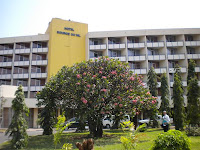
Their taxi in front of the American Embassy, Hotel du Nil and a Bujumbura street
They were impressed with the city. It's streets were generally asphalted or cobblestone and without many pot holes. It was clean and seemed to be moving forward. People were helpful & interested in their missionary message. They spent the week investigating things in Bujumbura and had a wonderful experience.
  
They went into the hillsides overlooking the city, which they said reminded them of the Salt Lake Valley with its east bench mountains...
to the enormous open air market...
 
and to see stores, houses and apartment buildings in town.
  
It appears that Bujumbura is a progressive and growing city with many things to recommend it.

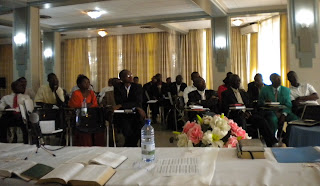
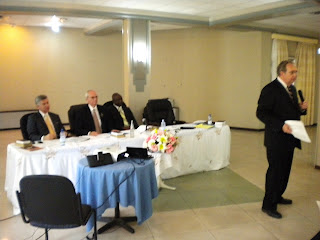
On day two, they held an exploratory conference. We have been in touch with a few members in Burundi and some pastors who use the Book of Mormon in their churches and have been asking us for some time to come to there. In planning the conference they decided to make the meeting by invitation only to keep the size manageable. They could have had many more people, but felt it best to just have a small group. They tried to include some members of each congregation and all of the actual members of the church that they could contact.
All those who attended the Conference
Informal discussions were enjoyed at lunch
 
One couple, the Malabis, wrote to us just before the men left for Burundi. We had seen their name in paperwork from earlier visits by leaders, but thought they had moved from Burundi. They are members and had just heard about the conference. They have been waiting five years for the day when the church would come to Bujumbura and they wanted to be at the conference.
As the people at the meeting introduced themselves, Brother Malabi, said that he and his wife and four children where all members, but some of them were just not baptized yet .
They had moved to Burundi from Tanzania and had found no official church unit in Bujumbura, so their younger children were not able to be baptized when they reached the age of 8. They had no permission to do the sacrament either, so they obediently and faithfully held only Sunday School each week for five years. Each month they took a portion of their money and used it to help somebody in need, since they couldn't pay fast offerings. They put their tithing in a special bank account and have saved it for five years, waiting for the time when somebody from the church would come to Burundi & accept it. What an amazing example they are of how devoted and self-motivated we should all be.
Several of the "pastors" introduced themselves by saying that they had been "in the church" since 2001 or some other time, but had not yet had the opportunity to be baptized. It was quite a remarkable experience.
 
The Malabis, missionaries and Pastors who attended.
On Sunday they held a Sacrament meeting in the hotel for the members only. There were 15 in attendance. In this meeting these wonderful members were able to have the experience of blessing, passing and taking the sacrament for the first time in five years. It was a very special experience for all who attended.
The rest of the week was spent looking for possible church sites, apartments and at the general living conditions in Bujumbura. There are many factors to consider when looking at this country.
We are excited to see the future of Burundi.

Sunday, August 22, 2010

Our Sabbath in Kasabelesa


Kasabelesa is a city just inside the southern panhandle of the Democratic Republic of the Congo. It sits right on the border of Zambia.  Elder and Sister Jameson took us to one of their favorite little congregations here. They are not yet a Branch but only some paperwork is holding that up.
 We drove through about an hour and a half of very poor villages that are the humblest of homes.  When we arrived into the city, it was still very much village-like with a few larger brick buildings.  We drove off the main road onto a dirt area between small homes and walls into a gated walled area that looked much like an old, abandoned, shabby prison.  Little did we know that it is a fully functioning grade school.  Each school day there are 1000 children that come to learn french, writing and arithmetic.  500 children come in the morning and 500 come in the afternoon.  There were only 15 rooms just like the one you see us standing in front of.  The buildings were all facing into a dirt courtyard. The director/teacher is a member of the church and since there is no chapel for the members to meet in, he has allowed them to meet at the school buildings.  As we began the meeting, and sat on the benches pictured, we sang acapella 6 hymns and they love to sing!!! The priesthood leader then announced an opening hymn that we would sing and then a prayer.  The 20 primary children then left the main room pictured above and went with the only young woman (14 yr. old Rachelle).  She was the primary leader.  The children were all very well behaved and respectful to her.  Rachelle knew a little English and was really adorable. The Priesthood leader taught our Sunday School lesson on the Gifts of the Spirit.  He was a good teacher.  After the first hour, the children rejoined the adults for a Sacrament Meeting. Oh, before the meetings began, two men wanted to wash their hands before they prepared the sacrament.  They went out into the middle of the courtyard and began to pull and pull and pull a long rope out of what looked like a large bucket.  It was a deep well!!  After all of the heaving, up came a bit smaller bucket of water from what seemed like the center of the earth!  They poured it into their bowl and washed for the preparing of the bread.  They used bottled water for the sacrament water thank goodness!
We four missionaries were asked to share our testimonies for sacrament meeting.  I was first.  My french is improving but I still have to write it down and then read it.  I also shared  2 scriptures from 2 Nephi.  I can read french aloud quite well now. The other 3 missionaries are speaking french naturally.
While the sacrament is passed, you can hear a pin drop inside the room.  But outside the compound, it was very, very noisy.  Over one wall, there was another congregation singing loudly, trilling and playing drums, which was their worship service.  Over the opposite wall, there was a pastor with a loud microphone system, yelling his sermon very loudly.  And every little while there were sounds of chickens and an occasional rooster crowing.  But the contrast did not stop the sweet spirit of the Lord that we felt as we worshipped.   In this little congregation, there were 28 adults and 20 children. The African people are very religious mostly but there are many pastors that make their living and take alot of money from these people who have so little and who love and wish to worship Christ.  While we were there, three people were interviewed for baptism into the Church of Jesus Christ of Latter-Day Saints.  They were worthy to do so.  There are no full-time missionaries in this city.  The gospel is spread by the members who live the gospel and love it.  Hopefully, soon, native missionaries will be able to serve here. Here in Africa, the gospel is growing "poley-poley" which is slowly-slowly in Swahili, BUT it is steady and such a blessing to the people.  After the meetings were over, every adult and child came to shake our hands and thank us for coming to their congregation.  We are honored to be able to serve these kind and tender brothers and sisters who love their Savior and choose to follow Him.

Monday, August 16, 2010

Termite Mounds


There are termite mounds everywhere in Africa.  The fact that termites have lived there and then vacated makes the mound very fertile and trees and bushes grow readily on them.  The bigger they are, the more likely there are no termites living there any longer.  The mounds can be anywhere from one to 15 feet high. They also can be 10 to 12 feet across. They are all shapes and sizes.  In some places, there are many in one mile square.  Yes, the africans eat termites.  I understand they are a good source of protein.  These are not small termites, they are about the size of a bee. This may be a great blessing to the bush people for a source of food in the dry season. Blessings come in many ways.We are in the dry season now.  The dry season has no rain for six months. 
<><>
<>

Friday, August 13, 2010

More Scenes from "The Bush" on the way to Likasi!

<>
<><><><>
Here is another family getting ready for the day. Their home is made of brick walls and a grass roof.


<>
<><><><>
Here is a family in a mud walled home and grass roof.  Notice the lashing of the walls on the left, the cloth door, the young boys washing their faces, the wooden clothes line, and the black chicken in front.  Since the inside of the hut is used mostly for sleeping, their utensils and outside.  They live mostly outside their huts if the weather permits.
May these children of our Heavenly Father be blessed.  The more we get to know, the more we find that they are truly our Brothers and Sisters.
I apologize again for the mixed up photos.  The weak link on the internet here makes posting very difficult.  I hope you can see the small photos.  I tried to enlarge them all but they would not.

Tuesday, August 10, 2010

Scenes from "the Bush"on the way to Likasi

                                                                                                                                                                                                                                                        ZoneConference in Likasi was enlightening and well worth the trip for missionary reasons.  The ride in the car was bumpy and dusty. It took about two hours there. We took about 350+ photos because of the amazement we were in.  It is an area where people live very humbly. As you can see, there is no running water.  Therefore, most of the water is gathered at a river or a puddle.  They use the bidons (yellow containers) to carry water to their huts.  If you look closely, you will see people actually around and inside of their homes. Please notice that even around these humble homes, the dirt around the hut has been swept well and is cleared down to bedrock. They use whatever they can to make a shelter for themselves and their family members. There are so many of these types of homes and even communities of them.  These are the most humble of homes in the area.  May God bless these, His children.

Notice the well swept dirt.
Notice here that they have chickens and a garden!  They really do try their very hardest to survive!
<> 
<><><><>
I took this photos not realizing the woman was coming out.  The home must change when the rainy season comes! I tried to take these photos,  when no one was watching or from the car window.  You can understand why.

Friday, August 6, 2010

Businesses in Downtown Lubumbashi


A very small corner grocery store. There are many of these!
In a third world country, with millions of people, survival is a question of resourcefulness!  People here recycle everything! Many times they make a business with recycled things.  They sell used wheelbarrows, used clothing, used shoes, used bicycles, used books, used baskets, used hats, used appliances, even used water bottles. If you have a cell phone and an umbrella, you can start a corner phone booth of your own.  Just sell your own minutes. Many businesses are not even in a building. Many people sell their goods outside.  You will see young boys carrying dozens of eggs, all hard boiled with little salt cups to sell on the street to passers by.  We have an apple lady who sells the best apples in town outside on a street corner. Her apples are even better than the big grocery store.  There is a banana lady one block the other way and she carries all of her produce (pineapples and mandarin oranges) on her head, sit on the corner in the grass under a tree and is always there .  We passed a man today selling sparrows, blue ones, all alike, about 25 of them on a rope.  We passed a man in the bush selling field mice, alot of them on a string with long tails. The missionaries tell us that the field mice are really very meaty and delicious!  We have a gardner at our compound who takes plant starts from our yard and cuts empty water bottles up and sells the starts everyday in the bottom half of the bottles.  Even though most people have dirt floors and dirt drives, they sweep their dirt and keep it as clean as they can IF it is their land.  If it is not, they don't pick up litter.  The rural roads are terribly littered.  It is really just part of the culture.
The Jamesons, on assignment, just flew to a large village on assignment to divide three church branches into four.  They stayed in a motel (which was not what they expected) that only had electricity and water for 45 minutes a day. It was not sanitized in any way.  So, when they came back to Lubumbashi, they really appreciated the small efforts that people make to try and keep things clean!
When I asked them about the people, they said, "Oh, they were terrific!  They love the Lord and His gospel.  There was even one couple that were willing to move to another village in order to serve in the church!  When we got there, we knew exactly who was suppose to lead and what dividing lines need to happen.  This is the Lord's church and He is in Charge!"

I apologize for this blog.  The power kept going off.  The congo has weak internet, so this is my third hurried try before the power goes off again.  Thank you for your comments.  We love hearing from you.

Sunday, August 1, 2010

At the Open Air Market


Our first experience at the open air market was a real eye-opener.  This is huge and extremely busy.  It is the usual way that the Congolese shop.  We were the main attraction as we drove and got out of our car. First, because we were white people or "muzungus"(moozoongoos) (in Swahili). Secondly, because we drove a car (which is rare). There were literally thousands of people on every block with their goods for sale. On some blocks, they had clothing, baskets, hats, most of them piled on the ground on a cloth.
You can see they have potatoes, garlic, onions, beans, cracked wheat, cassava, cassava powder, leeks, green onions, bananas, apples, sweet potatoes, bell peppers, spices, rocks that they put in their mouths and hold in their cheeks to get calcium. You will never guess what is in the middle large pan that looks like it might be beans.  It is actually termites, large termites dried and crunchy. They also had dried catepillars, in different sizes; many types of dried fish, some very scary.
Most people live in one room homes with no running water and no power, so the sanitation standards are very low.  The sights, sounds, smells were amazing.  I did buy some beans (by the bucket), cracked wheat, tomatoes, green onions. We paid by Congolese Franc.  We wanted bananas but they were sold by the crate.  We had to boil the beans and cracked wheat for hours to sanitize. The product was delicious and we were not ill.  The tomatoes, green onions were soaked in soapy water and bleach, then soaked again in bleach water.
 Most of the people at these markets are the uneducated so they speak Swahili.  So as you an imagine, the communication is very limited.  Once in a while, someone would say, "Bon Jour, Madam" and we were excited! Most of the women are in traditional African clothing but some are just in anything they have.  The Congolese try to dress as nicely as they can. Because so many do not have jobs, they wear whatever they can get. Only a few major roads are paved and all the rest are dusty, dirt roads with many potholes. Most people are on foot.
Most of the goods are brought by bicycle with a rare truck or two. The bicycle is the basic mode for carrying goods.  I am not sure why but they do not use animals. They carry most things, if they do not have a bicycle or cart to pull, on their heads.  They are masters at balance.  The sizes, weights and huge amounts they can carry on their heads is astounding. Most of the women, with those loads on their heads, also have a baby on their back and hold another child's hand.
One of the things we are trying to teach the members is that men and women work together for their families, that they are equally yolked.  The culture in the Congolese has the women doing everything.  They take care of the children, the buying, the carrying, finding food, cooking the food, the laundry, getting the water (which is huge).  Men have the tradition that unless they have a regular job, like carrying goods on bicycles, they just watch.  Many of them are unemployed. The men in church rarely even sit with their wife and children at first, but they are learning and changing. It's good!
To the left, you will see an inner-city market.  It is a little nicer with purses, backpacks and luggage.  If you look directly behind it, you will see the spire of the newly dedicated Seminary and Institute building.  Sister Julie Beck was here about six weeks ago, just before we arrived to help in its dedication. There are many students anxious to hear the gospel of Jesus Christ. There is also a chapel in that building.  Our temporary mission office, that Craig and I serve in to organize the mission is in that S & I building.
It is a cultural adjustment to be in this culture of the Congo.  Each day we go by faith and know that He we will bless us in our efforts to bring the Gospel of Jesus Christ more fully to this area.  The members here are truly dedicated, loving and accepting. They love Jesus Christ, as their Savior.  They love their families.  We miss our home, family and friends and thank you for your love and support, but we are truly grateful for this challenge in our lives. You are in our prayers and we hope we are in yours!